




















Signs of Freon Leak in Refrigerator: The Real Ones and the Look-Alikes
The real signs of a Freon (refrigerant) leak, the look-alikes that cause most warm fridges, and what to do while a technician is on the way.
On this page
Quick answer
The main signs of a Freon leak in a refrigerator are both compartments warming slowly while the compressor runs almost nonstop, and an oily film on a tubing joint at the back. Water and smells are rarely refrigerant. Rule out dirty coils, a weak door seal and a stopped fan first; a real leak needs a technician.
Key takeaways
- A leak shows up as slow, steady loss of cooling in the fridge and the freezer, with the compressor running longer and longer.
- Water on the floor is never refrigerant: it escapes as a gas and tends to leave oil behind, not puddles.
- Dirty coils, a worn gasket or a stopped fan cause the same warm fridge and are easier fixes, so check them first.
- Never chip ice with a knife; one slip can puncture a line, and some newer fridges use a flammable refrigerant.
- Call a technician when the checks don't explain the warming, because finding and sealing a leak is EPA-regulated sealed-system work.
The milk is at 45 degrees, the ice cream is soft, and the fridge has been humming all day without a break. Someone tells you it's "out of Freon".
It might be, but a simpler cause is more likely. Freon is a brand name that stuck, and we use it for any fridge refrigerant. Below are the signs of a Freon leak in a refrigerator and the look-alikes. When it really is the sealed system, our refrigerator repair technicians find the leak and tell you whether fixing it makes sense. Our technicians are EPA 608 certified for refrigerant work.
Signs of a Freon leak in a refrigerator, and the look-alikes
Here is what owners notice, and how strongly each sign points to a leak.
| What you notice | Points to a leak? | More common cause | Safe check |
|---|---|---|---|
| Fridge and freezer both warming slowly over days | Yes, a strong sign | Packed condenser coils, a stopped fan | Clean the coils; listen for the fans |
| Compressor running almost nonstop | Yes, together with warming | Dirty coils, a weak door seal, a hot garage | Check the door seal and the space around the fridge |
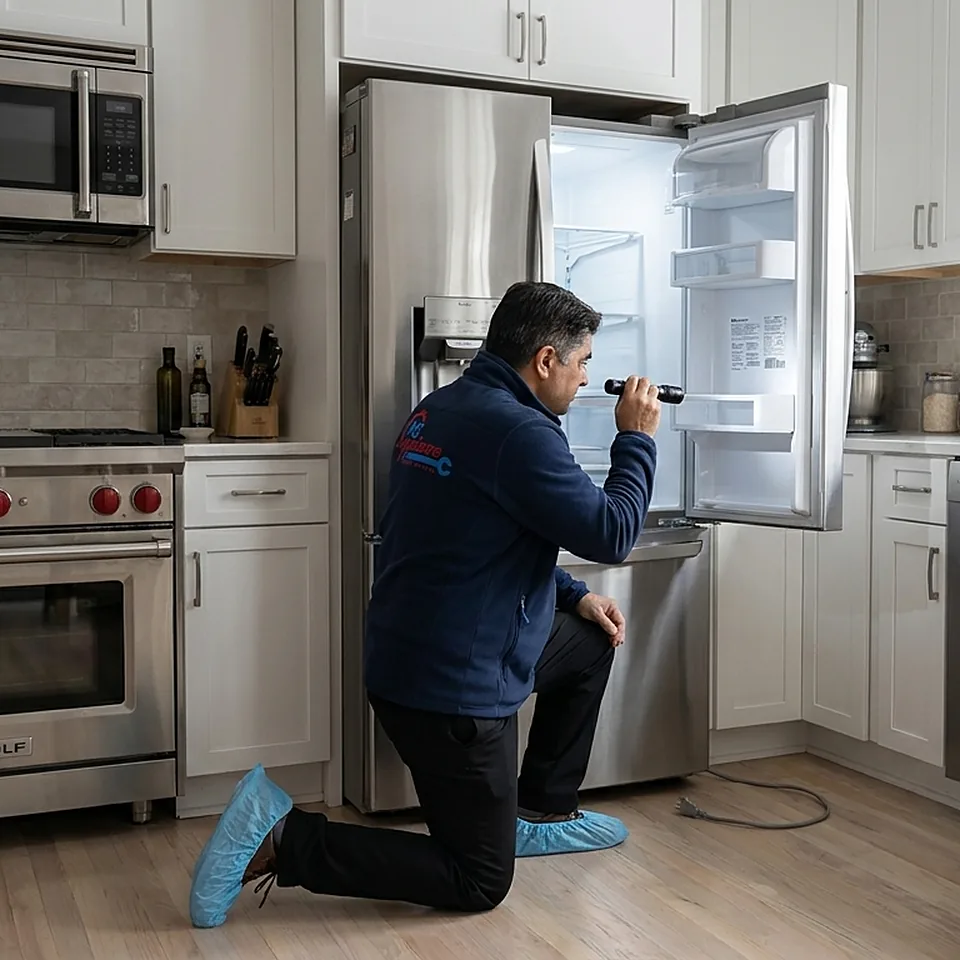
| Oily, dusty spot on a tubing joint at the back | Yes, a classic sign | Spilled cooking oil | Look with a flashlight; don't touch or remove covers |
| Hissing right after something hit or pierced a line | Yes | Normal gurgles and hisses during each cycle | Listen; unplug and call if a line was hit |
| A higher electric bill | Only with the signs above | Dirty coils, a weak door seal | Compare with last season; clean the coils |
| Thick frost blanket over the freezer's back panel | No | A defrost problem | Note it for the technician |
| Water on the floor or inside | No | A clogged defrost drain or a water line | See the water-leak guide linked below |
| A chemical smell | Rarely | Spoiled food, a dirty drain pan, new plastic | Clean and check the drain pan area |
Refrigerant doesn't puddle. It leaves as a gas, and the compressor oil that travels with it marks the spot as a dusty, greasy patch on a joint.
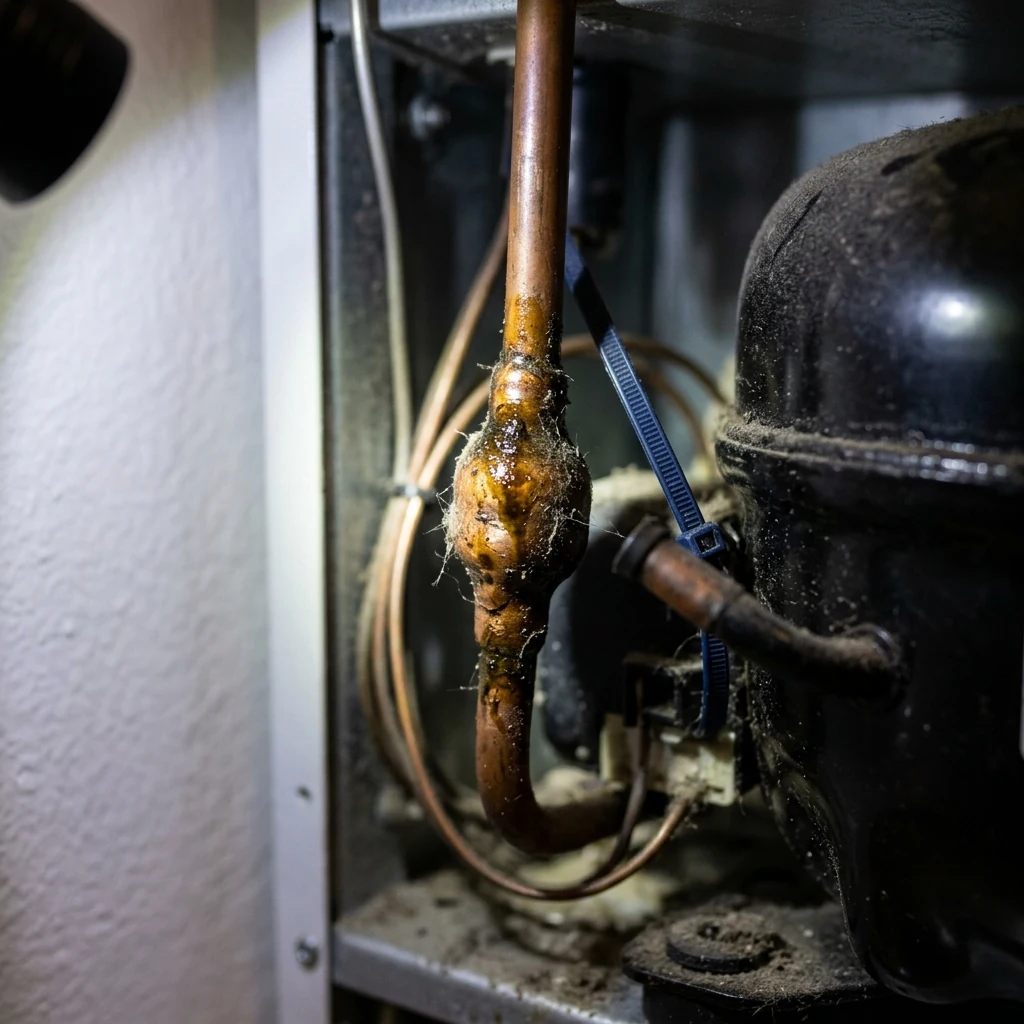
Smell is a weak clue: modern refrigerants have little or no odor. A rotten-egg smell is not refrigerant at all: that is natural gas from a gas range or a water heater. Leave the home, then call 911 and Nicor Gas from outside.
If your problem is water, our guide to an LG refrigerator leaking water covers the drain and water-line causes. If it's a new noise, see why a fridge makes a loud noise.
Rule out the common causes first
These checks are safe, and they explain many warm fridges.
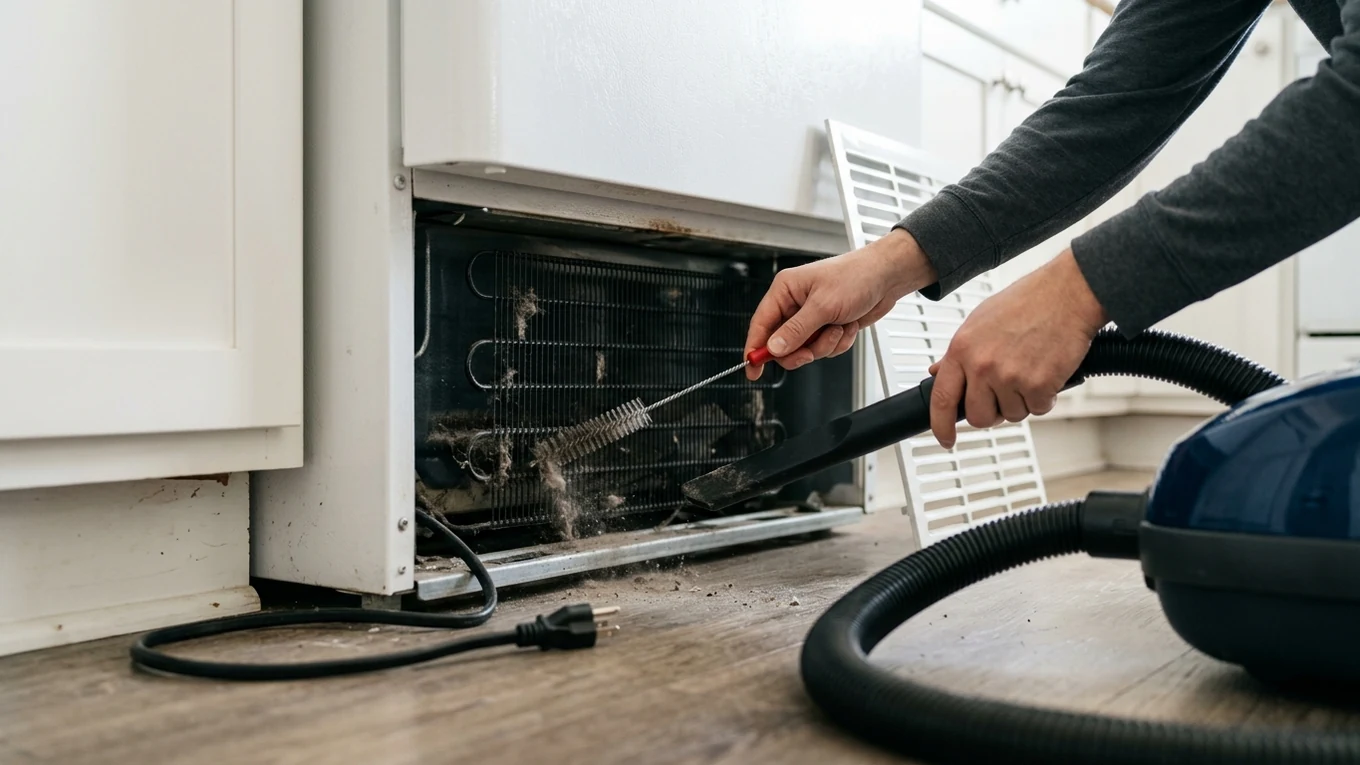
Safe checks before you suspect a leak
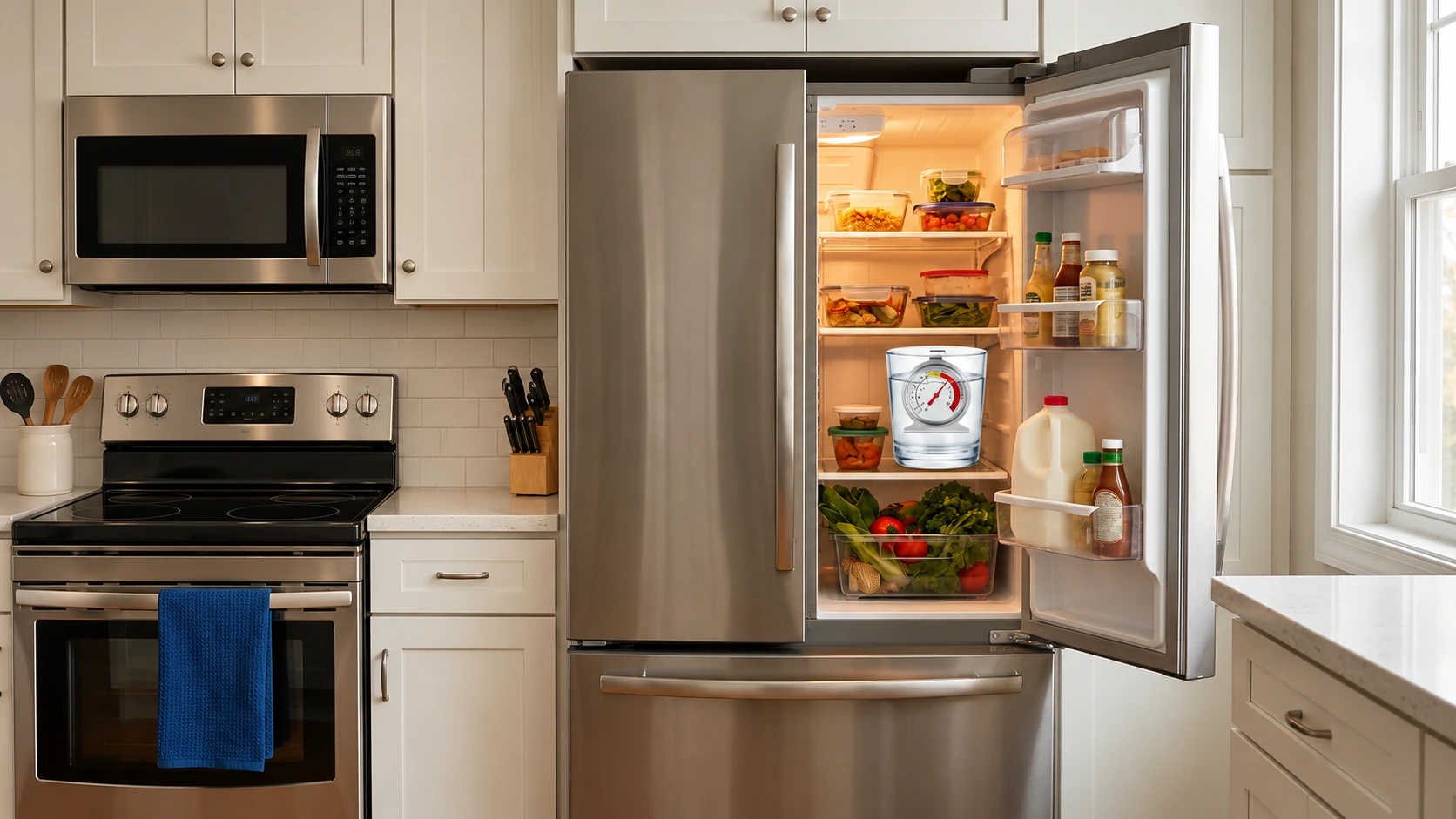
- Measure, don't guess. Put an appliance thermometer in a glass of water on the middle shelf for a few hours. The FDA says the fridge should be at 40°F or below and the freezer at 0°F or below.
- Unplug the fridge before you touch the coils. Pull it out gently or open the bottom front grille, depending on the model.
- Clean the condenser coils. Use a coil brush and a vacuum with a crevice tool. Packed coils make a fridge run warm and nonstop, the same signs as a leak.
- Test the door gasket. Close the door on a sheet of paper. If it slides out with no drag, that part of the seal is weak. Clean the gasket with warm soapy water and test again.
- Clear the vents inside. Move food away from the air vents in the fridge and the freezer so cold air can circulate.
- Plug it back in and listen. With the doors shut, you should hear a steady fan whir in the freezer, and on many models a second fan near the compressor. Give it a full day and measure again.
If the coils were packed with dust and the fridge is back to 37°F the next day, you had a cleaning problem, not a leak. Our fridge cleaning guide covers the rest of the job.
Why a refrigerator doesn't run out of refrigerant
Refrigerant isn't fuel. It travels around a sealed loop of tubing, from the compressor through the condenser coils to the evaporator behind the freezer panel and back, over and over for the life of the fridge.
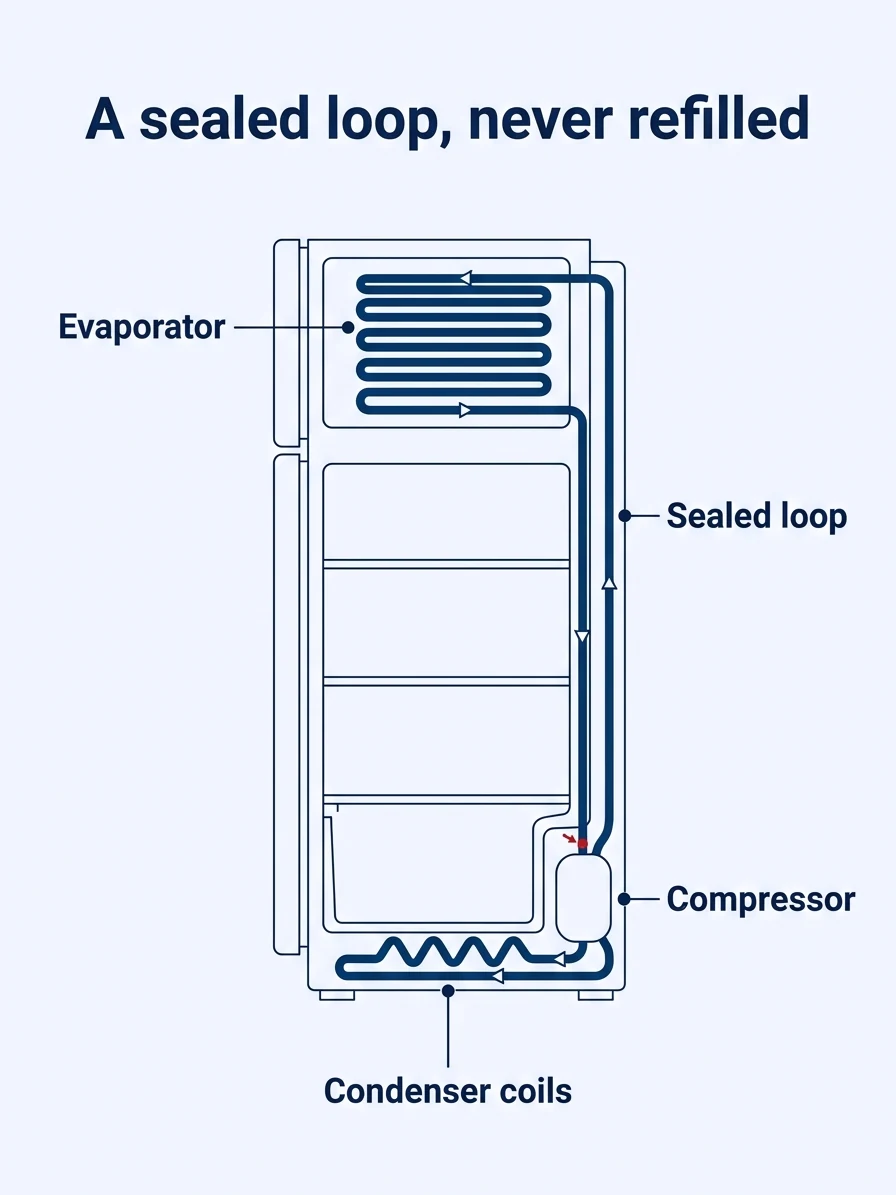
So a fridge that is low on refrigerant has a leak, full stop. Topping it up without finding the leak only buys time until it leaks out again.
The amounts are small. The EPA puts a typical household refrigerator at about 0.1 to 0.6 pounds of refrigerant, which is why even a slow leak shows up as warmer food within days or weeks. Older fridges used R-12; most from the mid-1990s on use R-134a, and many newer models use isobutane (R-600a). The type is printed on the rating label.
What to do while you wait, and what never to do
A suspected leak isn't a reason to panic. A household fridge holds only a few ounces of refrigerant.
- Protect the food. Move perishables to a cooler with ice if the fridge is above 40°F. The FDA says to throw out perishables that sat above 40°F for 4 hours or more.
- Let air in. If a line was punctured, open a window, keep children and pets out of the kitchen for a while, and keep open flames away. Fridges that use a flammable refrigerant carry DANGER and CAUTION labels near the evaporator, the machine compartment and exposed tubing.
- Never chip or pry ice. Those labels warn against mechanical defrosting and puncturing the tubing. Unplug the fridge and let ice melt instead.
- Skip the recharge kits. A fridge is filled by weight, measured in ounces, after the leak is sealed and the system is pulled into a vacuum. Adding refrigerant to a leaking system just loses it again.
The sealed system is regulated work. The EPA requires technicians who service or repair equipment that could release refrigerant to be certified under Section 608, and opening the system needs recovery equipment, a vacuum pump and a scale. This is the one fridge repair where we never suggest DIY.
You'll know the service call before we arrive: a fair, upfront fee that depends on your location and the appliance. You get a written estimate before any work, and if a sealed-system repair doesn't make sense, we'll say so: you pay only the service call.
Is a refrigerant leak worth repairing?
It depends on where the leak is, what else has failed, and the fridge's age. A sealed-system repair means finding the leak, repairing it, pulling a vacuum and recharging, and sometimes replacing the compressor or a coil, so it is one of the bigger refrigerator repairs.
| Situation | Usually |
|---|---|
| Fridge under 5 years old, or still under its warranty | Repair; check the warranty first, since the sealed system is sometimes covered longer than the rest of the fridge |
| A reachable leak at a joint, compressor healthy, fridge 5 to 10 years old | Get a diagnosis and an estimate; often worth fixing |
| A premium built-in (Sub-Zero, Viking, Thermador, GE Monogram) | Repair is often worth it, because replacing a built-in costs far more |
| Leak inside the foam walls, or a failed compressor on a fridge past 10 years | Usually replace |
| Second sealed-system leak on the same fridge | Usually replace |
If you're unsure, an honest diagnosis and inspection visit gives you the facts before you spend money on a repair or a new fridge. If your fridge also shows a code, see our guides to LG refrigerator error codes and the Frigidaire H1 code.
Frequently asked questions
What are the signs of a Freon leak in a refrigerator?
The strongest signs are both compartments warming slowly over days while the compressor runs almost nonstop, and an oily, dusty spot on a tubing joint at the back. Before you assume a leak, clean the condenser coils, test the door seal and clear the vents. If the fridge still warms up after that, a technician can test the sealed system and confirm whether it is leaking.
Can a refrigerant leak in a fridge make you sick?
A household fridge holds only about 0.1 to 0.6 pounds of refrigerant, according to the EPA, so a slow leak is a small amount. Some newer fridges use a flammable refrigerant, though. If a line is punctured, open a window, keep children, pets and flames out of the kitchen, and call a technician. If anyone feels unwell, get fresh air and medical advice.
What does refrigerant smell like?
Refrigerants in modern fridges have little or no smell, so a chemical smell from the fridge usually has another cause, such as spoiled food, a dirty drain pan or new plastic parts. A rotten-egg smell in the kitchen is natural gas, not refrigerant. Leave the home, then call 911 and Nicor Gas from outside.
Can I add Freon to my refrigerator myself?
No. A fridge is a sealed system filled by weight, and refrigerant only runs low when there is a leak, so adding more without sealing the leak just loses it again. Never add refrigerant yourself, whatever a kit says. The EPA requires technicians who repair refrigerant equipment to be certified, and our technicians are EPA 608 certified for refrigerant work.
How much does it cost to fix a refrigerant leak?
It depends on where the leak is, whether the compressor is healthy, and how easy the tubing is to reach. A leak at an exposed joint is a very different job from one inside the foam walls. A technician needs to test the system before anyone can quote it honestly. You get a written estimate before any work, and we'll tell you if replacing the fridge makes more sense.
Can a Freon leak in a refrigerator be fixed?
Sometimes. A certified technician finds the leak, repairs or replaces the leaking part, pulls the system into a vacuum and recharges it by weight. A leak at an exposed joint is often fixable. A leak inside the foam walls, or a failed compressor on an older fridge, often isn't worth it. A diagnosis and written estimate tell you which case you have.
Can a refrigerator run without enough Freon?
The compressor keeps running, but the fridge cools poorly because the evaporator can't absorb enough heat. You see both compartments warming while the compressor runs almost nonstop, which also wears it. If you suspect low refrigerant, get the fridge checked sooner rather than later, and move perishables to a cooler once it climbs above 40°F.
What to do next
Start with a thermometer, then clean the coils, test the door seal and clear the vents. Those checks explain a lot of warm fridges, and they are all safe with the power off.
If the fridge keeps warming, or you see an oily joint or a punctured line, leave the sealed system to a certified technician. Book a visit through our refrigerator repair page and you'll get a written estimate and a straight answer on whether the repair is worth it.
Sources
- US EPA: Transitioning to Low-GWP Alternatives in Domestic Refrigeration (fact sheet): Household fridges hold about 0.1 to 0.6 lbs of refrigerant; the move from CFC-12 to HFC-134a in the mid-1990s and the growth of hydrocarbon refrigerants such as isobutane (R-600a)
- US EPA: Section 608 Technician Certification: Technicians who maintain, service, repair or dispose of equipment that could release refrigerants must be certified
- Federal Register (EPA SNAP rule): use conditions and warning labels for flammable refrigerants in household refrigerators: Fridges with flammable refrigerants carry permanent DANGER and CAUTION markings, including warnings against mechanical defrosting and puncturing refrigerant tubing
- U.S. Food and Drug Administration: Food and Water Safety During Power Outages and Floods: Keep the fridge at 40 F or below and the freezer at 0 F or below; discard perishables held above 40 F for 4 hours or more
Written by
About us
MS Appliance Repair Services
Honest Repairs, Right at Home
Rated 5 stars on Google by 190+ homeowners in the Chicago suburbs
- Open 7 days, 8 AM to 7 PM
- Same-day service available
- 5-star Google rating from 190+ reviews
- 90-day limited parts and labor warranty on qualifying repairs
- LG-authorized
Serving Aurora, Naperville, Plainfield and 30+ cities across the Chicago suburbs.
Keep reading
All articles →
Frigidaire H1 Code: What It Means and What to Do
Frigidaire fridge beeping and flashing H1? It is the high temperature alarm. How to reset it, what to check, and when it means a repair.
LG Refrigerator Error Codes: What Each One Means and What to Do
Er IF, FF, CF, dH, gF, CH or CL on your LG fridge? What LG says each code means, what you can safely check, and when a technician is needed.
Frigidaire Dishwasher Error Codes: Meanings, Fixes and When to Call
i20, i40, CL, PF or flashing lights on a Frigidaire dishwasher? What each code means, the safe check for it, and when the code needs a technician.